Steve Jobs’ Vision

Sad news with the death of visionary leader and creative genius Steve Jobs at just 56.  If you have never watched Steve Jobs inspirational 2005 Stanford Commencement Address on ‘How to Live Before You Die’ it is well worth your time.

Vale Steve Jobs 1955 – 2011

And in his own words:

“Don’t let the noise of others’ opinions drown out your own inner voice.”

Steve Jobs

Thank you Steve, for your vision, for following your inner voice and for the extraordinary gifts you have left to the world.

Tributes:

“Steve was among the greatest of American innovators – brave enough to think differently, bold enough to believe he could change the world, and talented enough to do it.”

Barack Obama, US President

“He always seemed to be able to say in very few words what you actually should have been thinking before you thought it.”

Larry Page, CEO Google

“For those of us lucky enough to get to work with Steve, it’s been an insanely great honor. I will miss Steve immensely.”

Bill Gates, Microsoft co-founder and Chairman

“All of us would be touched every day … by products that he was the creative genius behind.”

Julia Gillard, Australian Prime Minister

“He was genuinely someone who changed the world.”

Tony Abbott, Australian Opposition Leader

Leave a comment below to add your tribute.

Mentoring Fact Sheet

A number of people have asked for a Mentoring fact sheet based on our recent article Seven Good Reasons to Set Up a Leadership Mentoring Program so we are happy to oblige.

You can download your mentoring fact sheet here:  Free Fact Sheet - Seven Good Reasons Why Mentoring Works


See below for resources that may help you develop an effective mentoring program:

Mentoring Adds Value

2630539049 37e633c709 m Mentoring Adds ValueThere are many ways that a mentoring program can add value to your company, association or organisation. Here are just some of them:

  • Mentoring is a very effective way to welcome new employees and induct them into your organisation’s culture and values or to support recently promoted employees.
  • Mentoring can offer effective support for minority groups or special employees and promote diversity.
  • A faciliated mentoring program can build a collegiate group which is more willing to share their experience and informal knowledge in a productive way.
  • Mentoring can assist in succession planning and the development of new leaders, provide a better basis for promotion and advancement decisions and shift high potential individuals onto the fast career track.

The messages that an invitation to participate in a mentoring program can be transformational.

QUOTE OF NOTE

“A lot of people don’t do great things because great things really aren’t expected of them and because nobody really demands they try.”
Steve Jobs

The power of demonstrating that great things are expected is immeasurable.  Mentoring really does add value.

Leadership Mentoring Program – Seven Good Reasons to Set One Up

2096003943 9b89b6a653 m Leadership Mentoring Program   Seven Good Reasons to Set One UpThere are numerous reasons why establishing a leadership mentoring program in your organisation may be one of the smartest things you can do, but here are seven good ones:

1. Attract and retain the best people. Some studies have shown that the presence (or absence) of a mentoring program means more than money to the decision to accept a job offer or remain with an organisation.

2. Modelling teaches more. Many of the core skills, attitudes, behaviours and ethics of leadership are best learnt by modelling rather than in a formal classroom. Mentoring allows your best people to model good leadership and offer practical guidance to your future leaders.

3. Mentoring encourages excellence. Mentoring is exceptional for its capacity to encourage excellence both in mentees and in those who mentor. While it might be expected that mentees might acquire insight and wisdom through working with a good mentor in a mentoring program, experience demonstrates that mentors also gain from the interaction. Mentors frequently explain that their role prompted them to review and reassess their assumptions and clarify their thoughts as they explain things to their mentee.

4. A well set-up leadership mentoring program enables you to recognise and reward your best people. By establishing an appropriate selection process for both mentors and mentees and providing the right framework to support this process you can ensure that participation in your mentoring program is sought by your best people, rather than perceived as a chore or a burden. Don’t take chances with this part of your program set-up as it is one of the critical requirements for its success. If you are not sure how to set things up to ensure best results call me on 03-9859 3924 and I am happy to advise you.

5. Build confidence and self-esteem through personal growth. Mentoring fosters not only professional growth but also personal growth, and can develop confidence in handling new situations, improve understanding of different approaches to a situation and enhance self-esteem for both mentors and mentees.

6. Improve cross-functional or interdepartmental communication and networks. Mentoring relationships are not usually set up between individuals with line management responsibilities. By establishing mentoring relationships between people from different areas of your organisation (or industry) greater understanding and improved cross-functional communication readily follow. Some organisations have found this benefit to be one of the most unanticipated yet valuable company-wide impacts of their whole mentoring program.

7. Foster a culture of contribution. Fundamentally the process of mentoring another always represents a generous gift by a busy person. It is a gift that can typically only ever truly be repaid in kind, over time, when the mentee in turn mentors someone else. As such, mentoring amplifies in its impact by embedding values such as respect, generosity and contribution in the corporate culture. This is arguably the ultimate and most powerful impact any intervention might have.

Check out Books on mentoring and setting up a leadership mentoring program below and in the Bookroom.

An effective leadership mentoring program can achieve all this and more.

Leadership Expertise – Quick Tips for Building it

2162700587 9948cd321b m Leadership Expertise   Quick Tips for Building itTo follow from our recent article on Leadership Styles and Being an Expert I thought I might share with you some Quick Tips for building your leadership expertise.

There really are only a few ways to build expertise. If you do need to rapidly build your leadership expertise here is how to do it:

  • Ask lots of questions. Don’t be afraid to ask others who know. Most people are more than willing to share their information if you ask for their help and advice.
  • Ask someone who already knows. Find a mentor or attend a course. Sign up for one of my seminars or courses, or contact us for details of individual or group coaching programs.
  • Make lots of mistakes. This is called gaining experience. It may be a painful, high-risk way to learn, but it is very effective if you reflect on the lessons you gain from your experience – and a great way to develop your leadership expertise.
  • Read lots of books. This is a much less painful way to learn from other people’s mistakes than making them yourself! Have a look at just some of the books in the Bookroom.

If you are doing lots of these four things regularly, your personal leadership expertise will develop much more quickly than otherwise.

Leadership styles – Being an expert in everything

2962194797 06b1dc08ac m Leadership styles   Being an expert in everythingOne of the first things we notice about good leaders is how many different yet effective types of leadership styles there are. While one of these leadership styles will be authentically right for you, and it might be very different to the leadership styles adopted by others in your organisation.

But regardless of your personal leadership style, there is one trap we find new leaders fall into, far too frequently.

No one person is an expert in everything and the fact that you are leading a team certainly doesn’t mean you know everything that everyone on your team does.

In fact, the job of a leader has more to do with knowing what needs to be known than knowing everything.

Once we know what needs to be known it becomes possible to acquire either that knowledge, or the people who have the knowledge. The most effective leadership styles reinforce this. Leadership styles that demand all-encompassing leadership expertise demotivate other team members.

Good leaders need to be confident enough in their own leadership styles and positions to be able to ask the people who do know, and to still take charge (without all the knowledge) when the situation requires it.

Yet so often when I am mentoring managers and executives I come across people who feel under great pressure to be an expert in everything, just because they are in charge. And their leadership styles reflect this. They are concerned that their lack of detailed knowledge of some of the things their team members are doing will make it too hard for them to earn the respect of their people or even undermine their authority.

But it isn’t necessarily so. I’ve known outstanding leaders who knew little about the technical detail of what their team members individually did who still displayed really effective leadership styles.

So much of your success in this sort of situation depends on your personal leadership styles.  In particular on the way you pay respect to the team members who do have the knowledge, without relinquishing your own role as team leader. Effective leadership styles achieve this by placing focus on the contributions of every of team member, including the team leader, rather than on individual deficiencies – even their own.

Expertise and Leadership Styles

However, there are plenty of things a leader does need to be expert in.

Even though good leaders may not know how to do everything each individual team member does, they will always know exactly what each team member contributes. They will know what needs to be done. They will know how to build a diverse group into a well functioning team, how to change attitudes and manage organizational change. They will know how and when to listen, and when to act.

All in all, when you are in charge of a team you need to be expert, not in the work your people do, but in all the knowledge, skills, attitudes and behaviours of being a leader.

Whatever leadership styles different effective leaders display, they all have this in common.

Leave a comment below to share what you think are the most effective leadership styles.

Is there a risk your key people make you vulnerable?

4988566409 eaf4936f4d m Is there a risk your key people make you vulnerable?In one of the seminars I present we do a quick organisational vulnerability audit or risk assessment. Regularly, participants list key person dependency as one of their organisation’s critical vulnerabilities.

The fact is that people do get hit by buses, laid low by the ‘flu, headhunted by competitors, or worse…

How well are you equipped to handle a risk such as the loss of one of your key team members?

What if it happened in the middle of a crisis? Or is there a risk that such an event would actually precipitate a crisis for you? How much valuable information or experience would you lose if you lost one of your key people? Can you affors the risk?

Easy risk management

One of your easiest protective actions is to ensure that your key individual’s second-in-charge is being mentored, coached and developed as a future leader and is aware of organisational issues beyond their responsibility.

Coaching or mentoring at each level in your organisation is a powerful way to encourage your team leaders and managers to think beyond their day-to-day responsibilities and contribute more to your business.  By recognising their value through a special coaching program you can also show your appreciation and develop their skills and commitment further at the same time as you reduce your own business risk.

Quote of Note

“There is no one who is successful today who has done the whole thing on their own …”

Jackie Stewart

I’ve heard some people say that training and developing people is a waste of resources because they might leave.

Smart leaders know that it is worse not to train and develop people, because there is a real risk they might stay!

See more details here on our Executive Coaching and Business Coaching Services

Investing in the development of your organisation’s current and future leaders is not just good risk negotiation, it’s essential to your long term business success.

Making connections

4188013326 3c6e65826c m Making connectionsI learnt a lot about making connections when I was giving a presentation to an industry association conference in Osaka, Japan, a while back.

All presentations were being translated simultaneously between English and Japanese.

The Japanese take their responsibilities as hosts of such a major international conference very seriously and their natural formality made it very difficult to ascertain their true response to most presentations.

A single word made the connection

One speaker, however, completely broke through the audience reserve and generated smiles and murmurs of delight with a single word.

The word was “Konnichiwa“.

A simple “Hello” inexpertly pronounced, but in their own language, created a stronger connection than any number of words expertly translated.

Whether we are making a formal presentation, leading a team or serving a customer, the key to building a relationship is making a connection.

There won’t often be a single word which can make that connection but communicating from the other person’s perspective rather than your own will always produce better results in any of your business (or personal) relationships.

Effective meetings – tips to make them happen

Perhaps you know some people who say there are never any really effective meetings. And it’s true that no matter how effective you might hope the meetings you organise are, there are often others present who think they could have done more important things with the time.

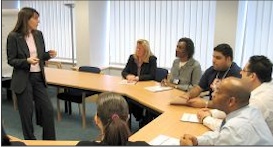
37056 4781 300x143 Effective meetings   tips to make them happenThe problem is that, in this busy world, everyone around the table has a lot of things they personally need to do – and those things aren’t necessarily what you called the meeting for!

So when you plan meetings you really do have an obligation to everyone present to make sure they are effective meetings which promote teambuilding and project success, rather than a waste of everyone’s time.

Meetings can actually be very effective, with the right meeting planning. There are a number of things you can do as a leader to ensure you hold effective meetings so here are four tips to make your meetings more effective.

First, effective meetings have a clearly understood and communicated purpose. There is nothing that makes a meeting more ineffective than when there is an unclear objective. Lack of clarity in your meeting ‘s purpose can even lead to meeting attendees working at cross-purposes. When you define the meeting objective clearly – and communicate it to attendees before the meeting begins – you will find the right people not only attend your meeting, but they come well prepared and participate fully. This is one of the most powerful ways to ensure your meetings are effective meetings.

Second, make sure the attendees are the right people who need to be there.  Don’t invite others who aren’t involved in the project and don’t neglect to include everyone who is.  If the right people are at your meeting, all the information you need will be available, decisions will be made more quickly, time won’t be wasted bringing people up to speed on issues or outcomes and teambuilding will occur by default as people begin to feel involved in the things that matter.

Third, make sure your meeting lasts as long as needed to achieve your outcomes – but no longer.  That doesn’t mean that sharing a cup of coffee or even a meal before or after your meeting is inefficient or a waste of time.  In fact it can be a great way to build team spirit – better even than many other team building exercises.  And if teambuilding is one of your objectives in organising the meeting you might even consider it an essential part of your meeting agenda.  However, if your meeting has a more focused purpose that is achieved in 20 minutes, don’t be afraid to conclude the meeting just because you asked people to set aside an hour for it.  You will find everyone will be delighted to move on to work on their other priorities.

And finally, if your meeting is critical, such as one for strategic business planning, a critical incident review or even just one where poor group dynamics is an issue, consider using a professional facilitator.  An external group facilitator will mean that you are able to fully participate in the discussions, rather than having to focus on the meeting process which is imperative in such critical situations.  Careful group facilitation can be the difference between achieving your meeting’s purpose or not – and after all, that is at the core of what effective meetings are all about!

If you are considering using a meeting facilitator download our Facilitation Fact Sheet for details about:

  • Why to use a professional facilitator
  • How to make the most effective use of independent workshop facilitation
  • When an external meeting facilitator can add most value to your meetings.

So, there are four simple yet powerful things that will make your meetings are effective meetings which promote good team building. Apply them now and you’ll become known as someone who always runs the most effective meetings.

Resources from Amazon for more effective meetings